Guide for the Kosher Traveler
מדריך למטייל הכשר
From airports and hotel buffets to tiny rentals and busy city streets: how to keep kosher wherever your journey takes you.
About this book →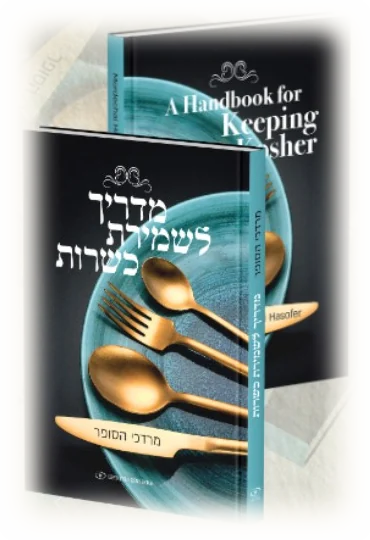
A Handbook for Keeping Kosher is a practical guide to understanding and observing the laws of kashrut in the modern world. It is written both for people beginning to keep kosher and for experienced readers who want a reliable reference, and it explains complex halachic principles in clear, everyday language.
The book covers the daily realities of a kosher home, and the new questions raised by modern appliances, food production and technology. It draws on Mordechai Hasofer's years of professional experience in kashrut supervision and food production.
A sample of the questions inside. Answers are summarised from the book; for any specific case, consult a qualified rabbi.
Use different colours for meat and dairy utensils and work surfaces.
Yes. Stainless-steel sinks can be kashered; porcelain and ceramic sinks cannot.
It cannot be kashered, because it is treated like earthenware fired in a kiln. If it has become non-kosher, the solution is dedicated interface discs or replacing the hob.
Keep a microwave for one purpose only, dairy or meat. If hot meat and dairy have mixed in it, it cannot be kashered.
Clean it thoroughly, leave it unused for 24 hours, then run it for two hours at its highest temperature.
Yes, if the water is poured into a clean, empty cup: the urn stays pareve. If milk or meat is already in the cup, the steam rising from it makes the urn's tap dairy or meat.
Yes.
A kosher fish has fins and scales. Since no fish has scales without fins, a piece of fish with its skin attached and scales visible on it is kosher. A loose piece of skin in the package is not enough.
From airports and hotel buffets to tiny rentals and busy city streets: how to keep kosher wherever your journey takes you.
About this book →Built on the Rema's Mechir Yayin: the hidden lessons of the Megillah, and how they speak to our lives today.
About this book →